GeoCond: A Conditioning-Aware Reliability Adapter for Feed-Forward 3D Reconstruction

Know when to trust feed-forward 3D

David Ahmedt-Aristizabal1, Mohammad Ali Armin1, Russell Tsuchida2, Lars Petersson1
1CSIRO, Australia 2Monash University, Australia
WACV 2027

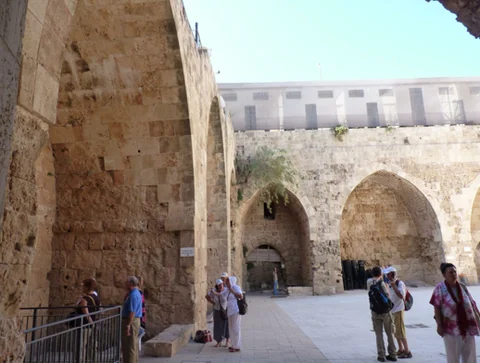
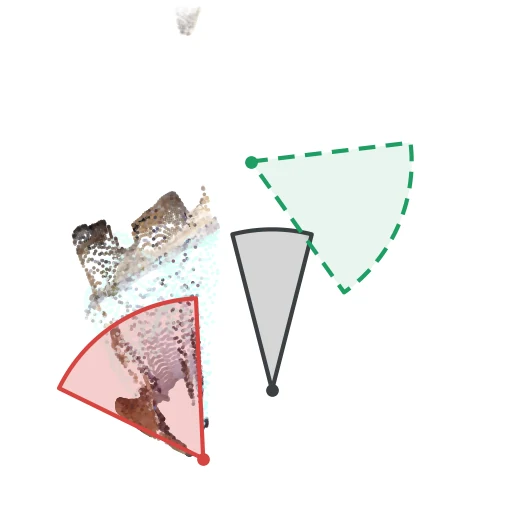
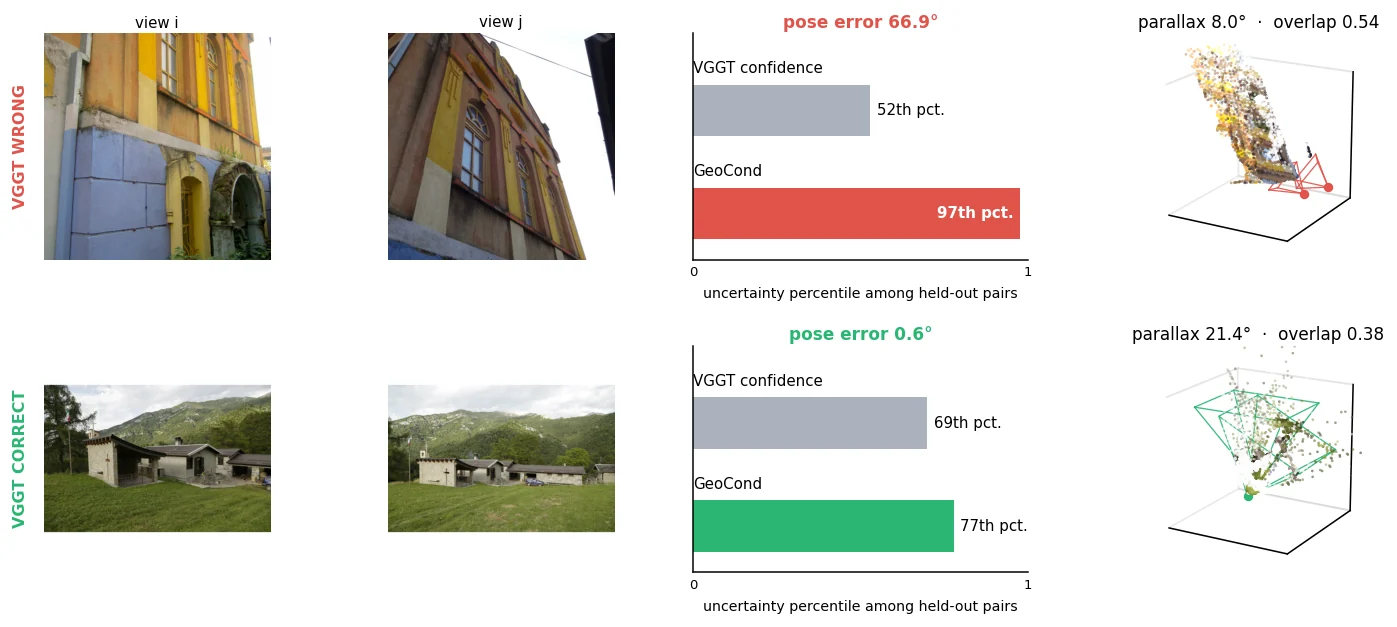
VGGT gets the pose of these two photos badly wrong, and its own confidence does not single the pair out. GeoCond reads the same forward pass and ranks the pair among the least reliable.

View 1 view 1
View 2 view 2
Bird's-eye map of the two cameras over VGGT's point map
  • view 1
  • view 2, VGGT's pose
  • view 2, true pose

Bird's-eye view; view 1 faces up.

VGGT pose error
Uncertainty percentile
VGGT confidence
GeoCond

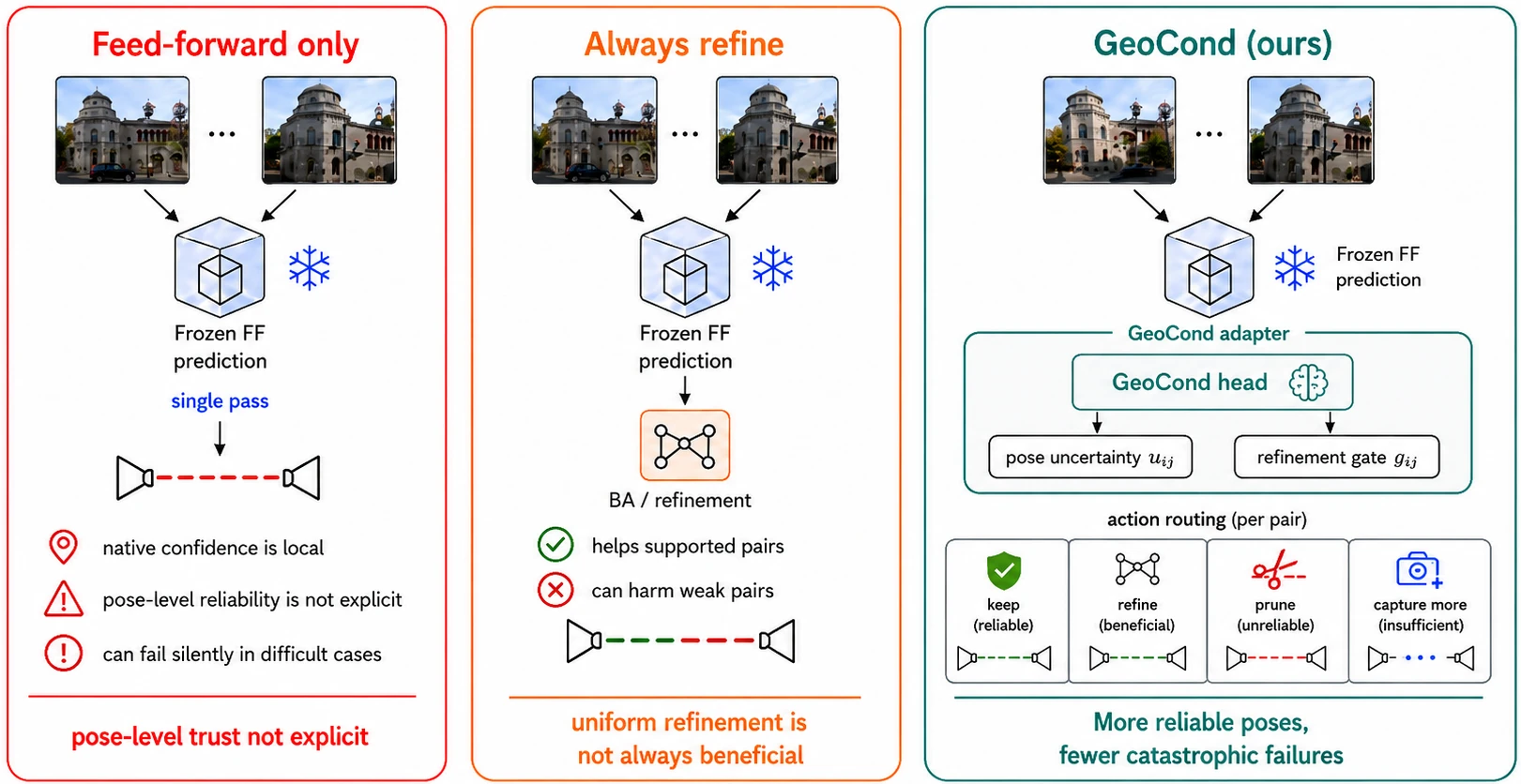
Three pipelines: feed-forward only, where pose-level trust is not explicit; always refine, where bundle adjustment helps supported pairs but can harm weak ones; and GeoCond, which adds a head on the frozen backbone that outputs pose uncertainty and a refinement gate and routes each pair to keep, refine, prune or capture more.

TL;DR: GeoCond attaches a 19.6k-parameter head to a frozen VGGT. From the same single forward pass it predicts how far each relative camera pose can be trusted and whether bundle adjustment is likely to improve it or make it worse.

Abstract

Feed-forward 3D foundation models such as VGGT predict cameras, depth, and point maps in a single pass, but can fail silently under low overlap, low parallax, and extreme relative rotation. Stratified analyses over these factors show that these failures are governed by geometric conditioning and are poorly captured by native aleatoric confidence.

We introduce GeoCond, a lightweight reliability adapter for frozen feed-forward 3D backbones. GeoCond reads geometric conditioning cues and the backbone's own stability signals and outputs pose-level uncertainty and a refinement gate. During training, it can be supervised by frame-permutation orbit variance, ground-truth pose error when labels are available, or cycle residuals from unlabelled independent pose graphs. At inference, the default head requires only one backbone pass and a small MLP.

On VGGT, GeoCond improves out-of-distribution (OOD) AUSE (area under the sparsification-error curve; lower is better) from 0.32 to 0.20 over native confidence on held-out outdoor scenes (and to 0.21 when trained on indoor data only) and avoids the collapse caused by applying bundle adjustment uniformly, without improving on feed-forward poses there. For three of six backbones, cycle-distilled variants provide a ground-truth-free adaptation route, including cases where permutation variance vanishes on equivariant models. The same reliability signal supports gated refinement, pose-graph weighting, calibration, curation, and capture decisions. Reliable feed-forward 3D reconstruction requires not only predicting geometry, but also knowing when that geometry should be trusted.
Feed-forward poses fail where the geometry is ill-conditioned

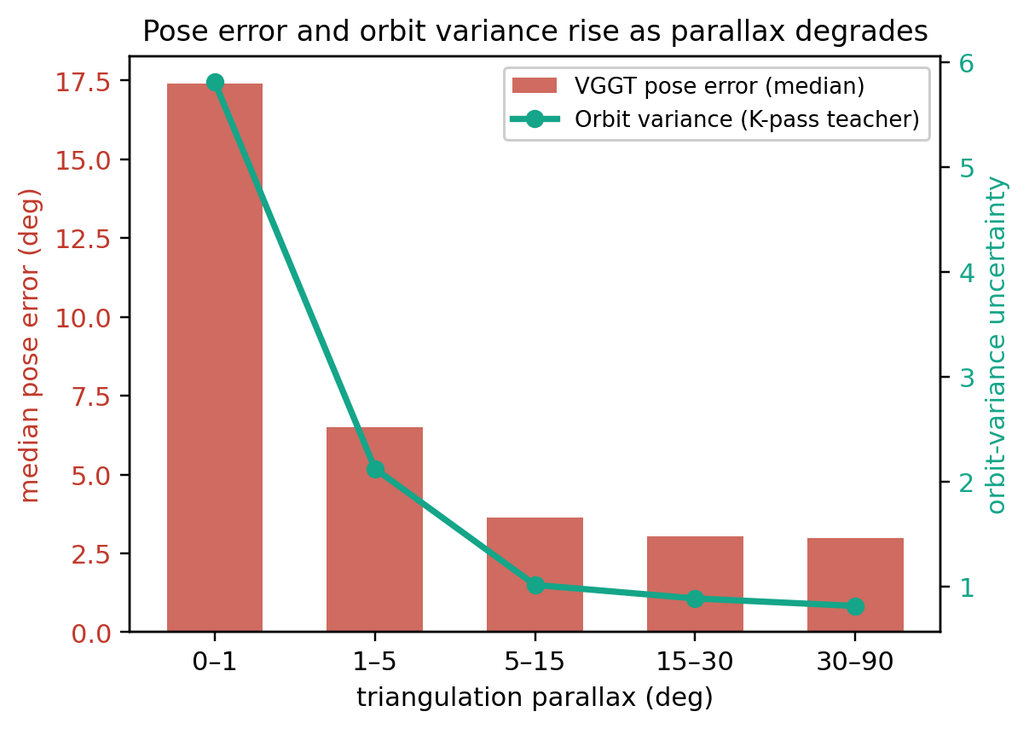
Bar and line chart: median VGGT pose error falls from 17.4 degrees at 0 to 1 degree parallax to about 3 degrees above 15 degrees parallax, and the orbit-variance uncertainty follows the same trend.
VGGT pose error (bars) and orbit-variance uncertainty (line) across parallax buckets on 7-Scenes.

On 7-Scenes, VGGT's median relative-pose error rises from about 3.0° at high parallax to 17.4° below 1° parallax, and 22% of those low-parallax pairs exceed 30°. Low overlap and large relative rotation have the same effect. The orbit variance, the spread of a pose when the frozen backbone is re-run on permuted frame orders, follows the error closely. VGGT's native per-pixel confidence does not.

The pattern repeats on MegaUnScene (outdoor, extreme views), MegaDepth-1500 and ScanNet-1500: a conditioning-based score ranks pose error better than native confidence on all six evaluation sets in the paper.

17.4°vs3.0°
median error below 1° parallax vs. at high parallax (7-Scenes)
44.2°vs3.3°
the same contrast on MegaUnScene outdoor extreme-view pairs
54%
of 7-Scenes office pairs with overlap < 0.01 fail catastrophically (error > 30°)
0.163vs0.323
AUSE of a conditioning-based score vs. native confidence on MegaUnScene (lower is better)

Stratified by overlap and relative rotation

DatasetBinnMed. errorCat. rate Native AUSE ↓GeoCond AUSE ↓
7-Scenes officeoverlap < 0.0122742.2°54%0.2630.284
7-Scenes officeoverlap 0.01–0.31126.8°11%0.1890.064
7-Scenes officeoverlap ≥ 0.33617.4°19%0.2130.142
7-Scenes officerotation < 30°3627.6°19%0.2070.139
7-Scenes officerotation 30–90°17911.0°20%0.2310.141
7-Scenes officerotation ≥ 90°15985.5°63%0.1780.204
MegaUnScene (OOD)overlap < 0.0149111.3°32%0.4290.251
MegaUnScene (OOD)overlap 0.01–0.33053.5°5%0.1930.165
MegaUnScene (OOD)overlap ≥ 0.310410.0°27%0.3850.285
MegaUnScene (OOD)rotation < 30°3235.7°14%0.3330.207
MegaUnScene (OOD)rotation 30–90°4005.2°21%0.2390.149
MegaUnScene (OOD)rotation ≥ 90°17718.7°40%0.5470.357

Table 2 in the paper. Held-out 7-Scenes office and MegaUnScene pairs, binned by ground-truth overlap and relative rotation. The catastrophic rate is the share of pairs with pose error above 30°. Out of distribution, GeoCond ranks pose error better than native confidence in every bin; on 7-Scenes office, native confidence is better in the two most extreme bins.

Method

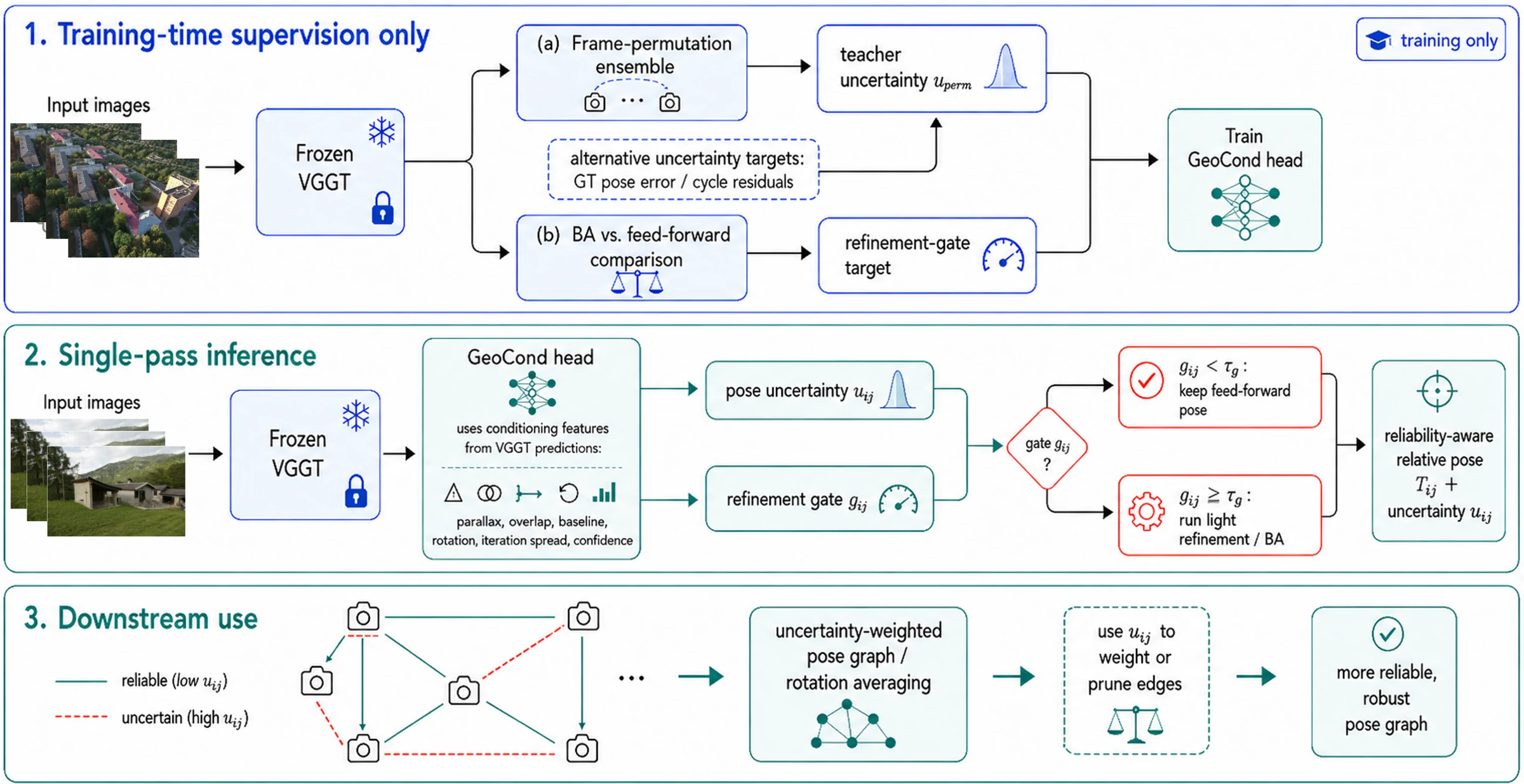
GeoCond is a small MLP applied to every image pair after one pass of the frozen backbone. During training, the frozen backbone also supplies the targets: a frame-permutation ensemble gives an uncertainty teacher, and comparing bundle-adjusted with feed-forward poses gives the target for the refinement gate. That comparison needs ground-truth poses. The backbone is never updated; only the head is optimised.

Method overview in three rows: training-time supervision from a frame-permutation ensemble and a bundle-adjustment versus feed-forward comparison; single-pass inference in which the GeoCond head reads conditioning features and outputs pose uncertainty and a refinement gate; downstream use of the uncertainty to weight or prune pose-graph edges.
Overview. (1) Training-time supervision, (2) single-pass inference with a per-pair refine-or-keep decision, (3) downstream use of the uncertainty in pose-graph fusion.

Seven inputs per pair

All computed from the backbone's own predictions in the single forward pass.

Geometric conditioning cues

  • triangulation parallax
  • co-visibility (overlap)
  • baseline
  • relative rotation

Backbone stability signals

  • camera-head rotation and translation correction across its iterations
  • native depth confidence

Two outputs

  • Pose uncertainty uij: ranks, prunes, calibrates or weights relative poses.
  • Refinement gate gij: keep the feed-forward pose, or run light bundle adjustment.

The head has 19.6k parameters and takes 0.17 ms per ten pairs, 0.2% of a 95.6 ms VGGT pass. The conditioning scalars add 3.5 ms per five-frame tuple on the GPU; one bundle-adjustment call costs 4.0 s.

Three ways to supervise the uncertainty

GeoCond-O orbit-distilled (default): spread of the relative pose over K = 6 frame permutations. Training-time only.

GeoCond-E error-supervised: pose error, where target-domain labels exist.

GeoCond-C cycle-distilled: loop-closure residuals of independent pose graphs. No ground truth needed, and it works for permutation-equivariant backbones, where orbit variance vanishes.

Qualitative examples

Frozen VGGT-1B with the scalars-only GeoCond head. Use the arrows, the dots or the keyboard to browse.

Results

Uncertainty and gated refinement on VGGT

Method Uncertainty AUSE ↓ Final AUC@30 ↑
indooroutdoor / OODindooroutdoor / OOD
Native aleatoric (VGGT)0.190.32––
GeoCond-O (mix)0.170.2053.558.4
GeoCond-O (7S), zero-shot0.210.2153.047.8
Feed-forward always––51.660.3
BA always––53.638.4
Orbit variance (K = 6, teacher)0.170.16––
Oracle––56.060.9

Table 3 in the paper. Scene-disjoint evaluation on held-out indoor (7-Scenes) and outdoor (MegaUnScene) scenes. AUSE ranks pose error; final AUC@30 is measured after the refine-or-keep decision. mix: trained on 7-Scenes plus MegaUnScene training scenes. 7S: trained on 7-Scenes only, so its outdoor column is strict zero-shot. BA: bundle adjustment. Bold marks the best deployable value per column; the teacher and the oracle are references.

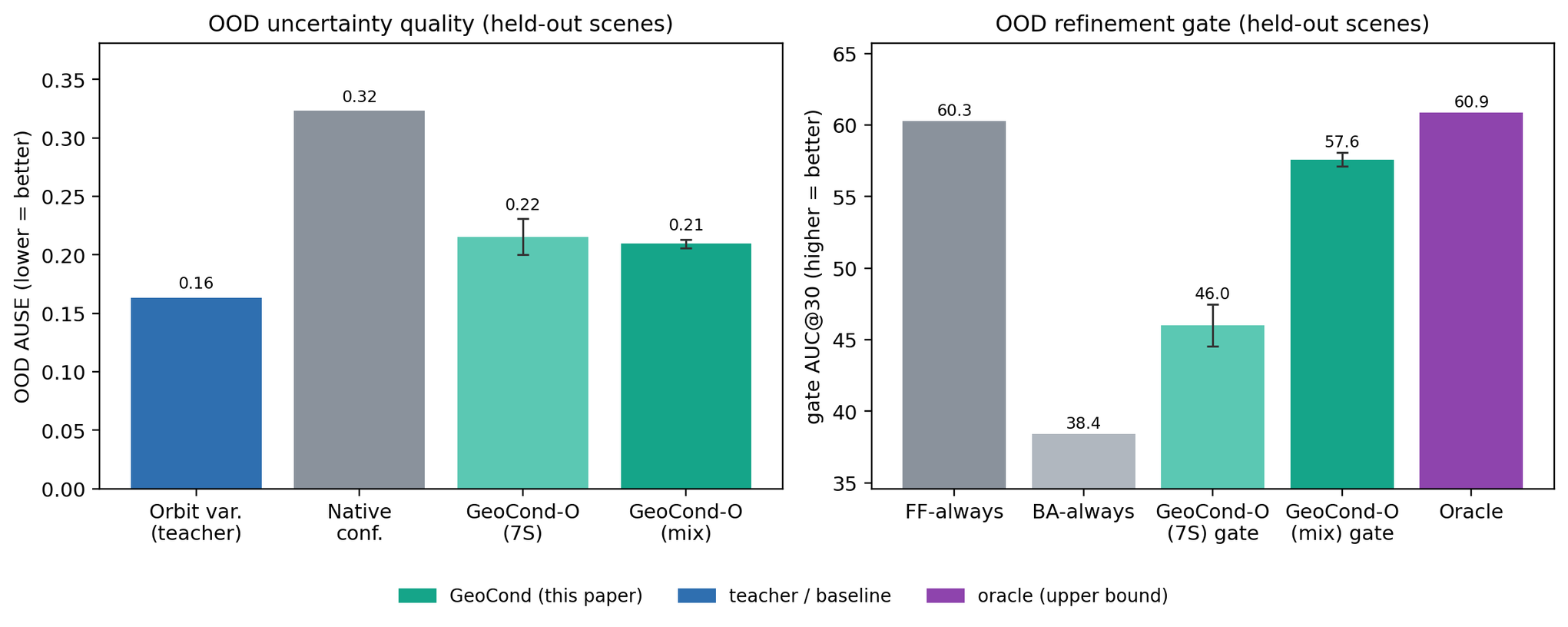
The one-pass head matches the six-pass orbit teacher indoors and lowers OOD AUSE from 0.32 (native confidence) to 0.20. Trained on indoor data alone it still reaches 0.21 (0.216 ± 0.015 over five seeds), so the uncertainty output transfers without target-domain labels. A five-member deep ensemble and MC-dropout reach comparable OOD AUSE (0.20 and 0.195) but need about five backbone passes.

The gate behaves differently in the two domains. Indoors it beats keeping the feed-forward pose (53.5 vs. 51.6 AUC@30) and is within 0.1 of always running bundle adjustment. Outdoors, always running bundle adjustment collapses to 38.4; the mix-trained gate avoids most of that loss (58.4) but stays below keeping the feed-forward pose (60.3). Out of distribution, its value is in preventing harmful refinement. The gate also does not transfer zero-shot (47.8): it needs labelled pairs from a domain where bundle adjustment behaves as in the target.

Two bar charts on held-out OOD scenes. Left, AUSE: orbit teacher 0.16, native confidence 0.32, GeoCond-O 7S 0.22, GeoCond-O mix 0.21. Right, AUC@30: feed-forward always 60.3, BA always 38.4, 7S gate 46.0, mix gate 57.6, oracle 60.9.
Held-out MegaUnScene scenes, mean and spread over five seeds. Left: uncertainty ranking. Right: refinement policies. These five-seed means differ slightly from the values in the table above.

Which features matter

Input set indoor AUSE ↓ OOD AUSE ↓
AUSEΔAUSEΔ
all conditioning features (default)0.165±0.006+0.0000.209±0.004+0.000
− parallax0.149±0.003−0.0160.213±0.003+0.003
− overlap / co-visibility0.157±0.003−0.0080.215±0.003+0.005
− baseline0.161±0.006−0.0040.202±0.004−0.007
− relative rotation0.172±0.008+0.0070.200±0.004−0.009
− camera-head correction (rot. + trans.)0.191±0.003+0.0260.273±0.005+0.064
− native confidence0.210±0.005+0.0450.227±0.006+0.017
native confidence only0.250±0.020+0.0850.339±0.003+0.130
geometry only (parallax, overlap, baseline, rotation)0.365±0.016+0.2000.359±0.009+0.149
stability only (camera-head correction, native conf.)0.193±0.008+0.0280.246±0.003+0.037

Table 5 in the paper. The GeoCond-O (mix) head is retrained in the protocol of the table above after removing one feature or feature group; mean ± std over five seeds. Δ is the paired AUSE change against the full head, where positive is worse.

The largest OOD degradation comes from removing the camera-head correction (0.209 to 0.273), and the largest indoor degradation from removing native confidence (0.165 to 0.210). These backbone stability signals carry most of the ranking: alone they reach 0.193 / 0.246, against 0.365 / 0.359 for the four geometric cues alone. Individual geometric cues are partly redundant, but together they improve on the stability signals by 0.03–0.04 AUSE.

Adapting to other backbones

BackboneNativeVGGT-trainedGeoCond-EGeoCond-CCycle fusion*
VGGT0.279(0.230)0.2300.2870.108
π30.3330.2860.2210.1870.108
DUSt3R0.1820.4600.1620.2110.119
Fast3R0.2380.2300.1840.1850.132
CUT3R0.3910.3340.3140.3050.150
MapAnything0.2090.4960.2400.2510.147

Table 6 in the paper. AUSE ↓ on independent MegaUnScene edge sets; best single-pass value per row in bold. For VGGT, the VGGT-trained head is GeoCond-E itself. *Cycle fusion combines the score with raw cycle residuals at inference, so it needs independent-edge pose graphs and is not a single-pass score.

No single training source wins on every backbone. Error supervision beats native confidence on five of six backbones. The VGGT-trained head and the ground-truth-free cycle-distilled head help on π3, Fast3R and CUT3R but not on DUSt3R or MapAnything. π3 is permutation-equivariant, so it has no orbit variance to distil; there the cycle-distilled head gives the best single-pass score.

Using the reliability signal

The same uncertainty drives four downstream decisions. For thresholded decisions it is first Platt-scaled into a failure probability.

64%vs36%
Curation. Pose pseudo-labels kept on MegaUnScene at a 10% target catastrophic-label rate, against native confidence at the same realised risk.
3.0vs3.85
Capture. Frames needed on average to match the accuracy of all eight, when capture stops on GeoCond's uncertainty for the captured set rather than on native confidence (best fixed count: 4.0).
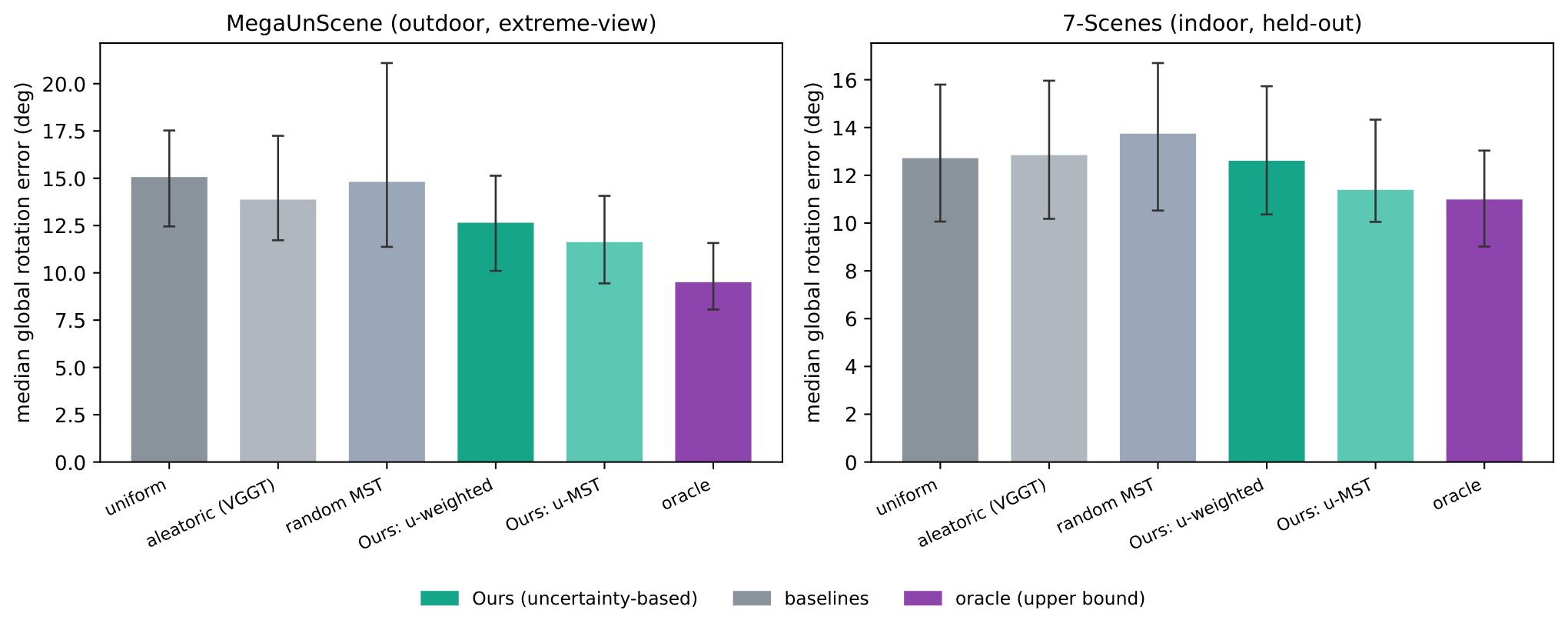
11.6°vs15.1°
Pose graphs. Median global rotation error on MegaUnScene with an uncertainty-selected spanning tree vs. uniform weighting (oracle 9.6°).
0.80vs0.66
Calibration. Out-of-distribution failure AUROC, GeoCond vs. native confidence. After Platt scaling, GeoCond's ECE is 0.038.
Two bar charts of median global rotation error after rotation averaging. On MegaUnScene: uniform 15.1, aleatoric 13.9, random tree 14.8, uncertainty-weighted 12.7, uncertainty-selected tree 11.6, oracle 9.6 degrees. On 7-Scenes the differences are smaller.
Rotation averaging of independent pairwise poses (six views, 80 view sets), median with interval. On held-out 7-Scenes, where catastrophic edges are rarer, the gains are smaller and not statistically significant.

A trust signal, not another reconstruction method

GeoCond does not predict geometry. The backbone and its output stay as they are; GeoCond adds, for every relative pose, an estimate of how far that pose can be trusted and whether refining it is likely to help, with a head that costs 0.2% of a VGGT forward pass.

Systems built on feed-forward models need exactly this to act on their output: keep a pose or refine it, weight it in a pose graph, discard it as a pseudo-label, or capture another view. Because GeoCond sits on a frozen backbone, the same recipe attaches to other feed-forward models without retraining them; we adapted it to five backbones besides VGGT, with results that depend on the backbone and on the supervision available.

Feed-forward models are fast enough to replace optimisation in many pipelines. GeoCond tells those pipelines when the output should not be taken at face value.

BibTeX

@inproceedings{ahmedtaristizabal2027geocond,
  title     = {{GeoCond}: A Conditioning-Aware Reliability Adapter for Feed-Forward {3D} Reconstruction},
  author    = {Ahmedt-Aristizabal, David and Armin, Mohammad Ali and Tsuchida, Russell and Petersson, Lars},
  booktitle = {Proceedings of the IEEE/CVF Winter Conference on Applications of Computer Vision (WACV)},
  year      = {2027}
}